
Surfing
Maya Gabeira: I just thought, ‘This is it, I’m going to die'
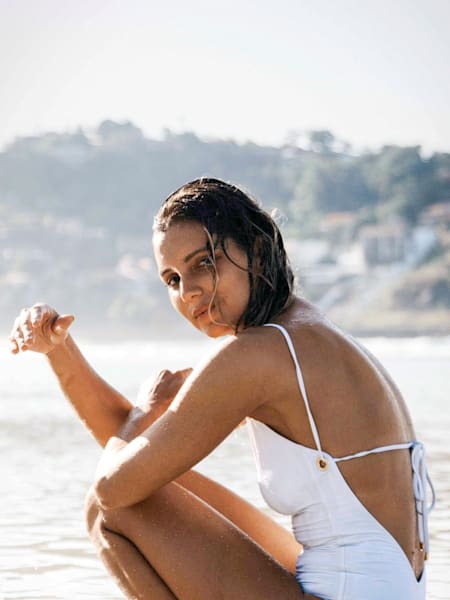
Few could turn a near-death experience into a historic triumph for women’s sport. But, thanks to skill, self-belief and a few thousand signatures, the Brazilian big wave surfer has done just that
In 2013, Maya Gabeira towed-in to a 25m wave during a monster swell at Nazaré, Portugal’s big-wave surfing mecca. Had she completed the ride, it would have been a record-breaking feat that entered her into the history books. But that day became historic for a different reason: she almost died.
“It happened so fast,” the 31-year-old Brazilian surfer recalls, thinking back to that disastrous day five years ago. “It was definitely the biggest wave I have ever seen.” The wipe out, which has now been viewed almost half a million times on YouTube, threw Gabeira from her board, ripped off her life jacket and pushed her underwater, breaking her fibula and knocking her unconscious. “I had this sensation of unbelievable sadness,” she says. “I just thought, ‘This is it, I’m going to die. This is not going to have a happy ending.’”
When Gabeira found her way to the surface, she was alone, unable to see, and had no means of communicating with her jet-ski partner, Carlos Burle. The wave held the surfer under two more times before Burle could make his way over to her and throw a rope. “I had a serious lack of oxygen, but I managed to get close to Carlos and get a bit of drag towards the on-side, to stop myself from being thrown towards the rocks,” she says. “That’s when I passed out.” Dragged from the water after a perilous nine minutes, she was given CPR on the beach, resuscitated and rushed to the nearest hospital.
The accident was reported globally and discussed at length. Surfing icon Laird Hamilton publicly shamed Gabeira for attempting the wave at all. “She doesn’t have the skill to be in those conditions,” the American said on CNN. “She should not be in this kind of surf.” Female big-wave surfing, then still a relatively new sport, was already controversial, and Gabeira quickly became the poster girl for those who believed a woman’s place was not in 25m swell. If she had decided on that day to leave big waves behind forever – with serious injuries, major surgery and a near-death experience under her belt – no one would have blamed her.
Related

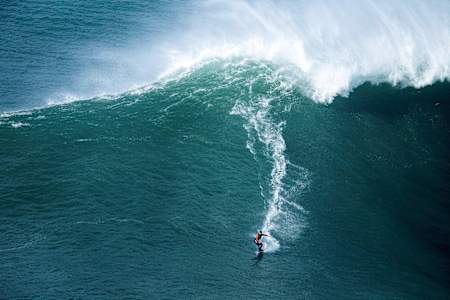
Gabeira in action in Nazaré, where, in 2013, a 25m wave almost killed her
© Hugo Silva/Red Bull Content Pool
Between the damage from that day and the back surgery that followed, Gabeira lost two years of her surfing career. Riding on and off, but never at 100 per cent, she clung to the belief she had to return to big-wave surfing and the record she’d been so close to claiming. But it seemed like a distant dream. “I had years of doubt about whether my confidence, my will and my ability to take risks was still there,” she says.
“There was lot of insecurity and fear. Fear of it happening again, fear of putting myself back in that spot. When you know what can happen, it’s hard not to think about it.”
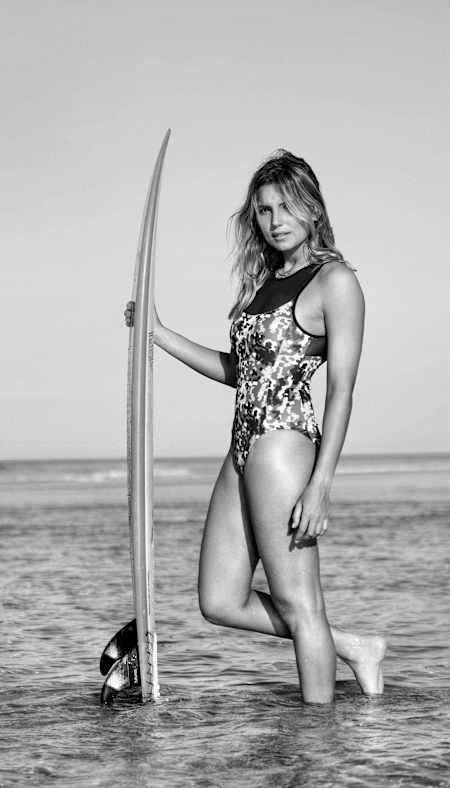
Since her first wave aged 14, Maya's become a pioneer for women in surfing
© Luiza de Moraes
However, by training herself back to full strength, Gabeira began to rediscover her old mindset. “The fact I put my body back together again to a high level of performance was the touch of confidence I needed to overcome the fear and ultimately face those really big days,” she says. “I got to the point where I was super fit and I trusted my mind, knowing I was now a thousand times more prepared than in 2013.”
Two years after her accident, with her strength and skill returning, Gabeira made a crazy decision: she moved across the world to Portugal, leaving her adopted home of Hawaii behind in order to be closer to Nazaré and the wave that almost killed her. Living locally, training, and getting back on her board helped her to prepare for the point at which her readiness would coincide with the arrival of another momentous swell at Nazaré. That came last January, just over two years after she’d returned. The bay’s deep offshore canyon funnelled the ocean towards the headland, creating the seven-storey waves that had defeated her once before.
I waited three-and-a-half hours for the right wave; I knew it was going to be gigantic
“This time, I knew the place well,” says Gabeira. “On that day, I waited three-and-a-half hours for the right wave; I knew it was going to be gigantic.” She saw a giant peak coming towards her, just like four-and-a-half years before. But this time she saw it with an experienced eye – she saw its size, the wind across it, and the danger. She let it pass, choosing instead to tow-in to the slightly smaller wave that followed. But it was still large enough for Gabeira to make history. At almost 21m high, it was not only the most impressive wave surfed that day, it was the biggest wave ever surfed by a woman. She had done it. But little did Gabeira realise that a whole new kind of battle was about to come her way.
An independent expert was called to confirm the record-breaking wave. Gabeira had surfed the tallest part, he certified; she had cleared the ride, made it to the safe zone, and the wave was a record size. Gabeira waited for the World Surf League (WSL) to recognise the achievement and enter her into the Guinness World Records. Months passed with barely a response to her emails, then she was given assurance it was in hand and that she’d hear something soon. More months went by.
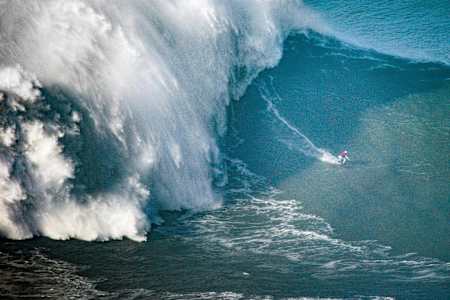
Gabeira's world record-breaking 20.72m big wave
© Bruno Aleixo/World Surf League
“I went to the [WSL] awards ceremony, and that’s when I realised it was never going to happen,” she says. “My wave wasn’t even shown that day. I realised I had to do something about it. I had to expose [the WSL] and put it out there publicly that the wave wasn’t being looked at. I needed everyone to ask why. I needed to show everyone that women don’t have the same platform [as men] for their waves to be judged.”
Turning to her fans for help, Gabeira launched a public petition and began to tell her story of the accident, of her journey back to Nazaré, and of the wave that was apparently being ignored by the WSL and Guinness World Records. She called their bluff. “It’s been a long time since I first read the Guinness book,” she wrote in her online petition. “I dream now of some other little girl who might read the book and see my name, then one day find her own big waves to ride… Ask the WSL to make good on their promise to recognise a world record for women in big-wave surfing.”
I believed it was only right that the record should exist for women as well as for men
The signatures began rolling in, first by the hundreds and then by the thousands. Her phone started ringing as newspapers and magazines across the globe wanted to find out more. “I had no idea whether I was going to get one signature or a thousand. I had no idea what would even count as a decent number,” she laughs. “We ended up collecting almost 20,000.” More important, as soon as Gabeira turned to the public for help, the WSL got in touch. “They got worried about their image,” she says. “They wanted to settle the case.”
Perseverance paid off. On October 1 last year, Gabeira stood on the WSL stage at the opening ceremony of the Big Wave Tour season and was presented with a Guinness World Record. It was the first awarded to a woman for big-wave surfing – a landmark moment for the sport. Accepting her award, Gabeira changed the landscape for all the women following in her footsteps, and created a new target for others to aim for. “I was the first one,” she says. “I’m proud that something is established; that a platform is there and other female athletes can come and not have such a hard task.”
Gabeira has an air of confidence when talking about the experience. But did she always have faith she would one day be accepting that award? “It was getting the wave recognised that I wasn’t sure was going to happen,” she says. Of her own ability, however, she never allowed herself any doubt, even after the accident. “I just love to work, and I had a clear goal and the will to achieve it. When you want to accomplish something, the real work is what you do when nobody is looking. Then, when that big day comes, you’re prepared.”
In 2013, Gabeira was seen by many surfers as a brave but foolish twentysomething girl who had surfed something bigger than she could handle and almost got herself killed. Yet, by refusing to allow other people to set her limitations, the Brazilian has defied all expectations. She is big-wave surfing’s greatest female record-breaker – a fact that shocked everyone but herself.
“I believed it was only right that the record should exist for women as well as for men,” Gabeira says. “That it was me who did it? I’m not that surprised. I was supposed to be the first one – I’ve been [doing] this for more than 10 years.” She pauses. “I must say, though, it turned out to be a bit harder than I thought it would be.”
This article is taken from the February 2019 issue of The Red Bulletin. To get the new issue delivered straight to your door, subscribe here.
